
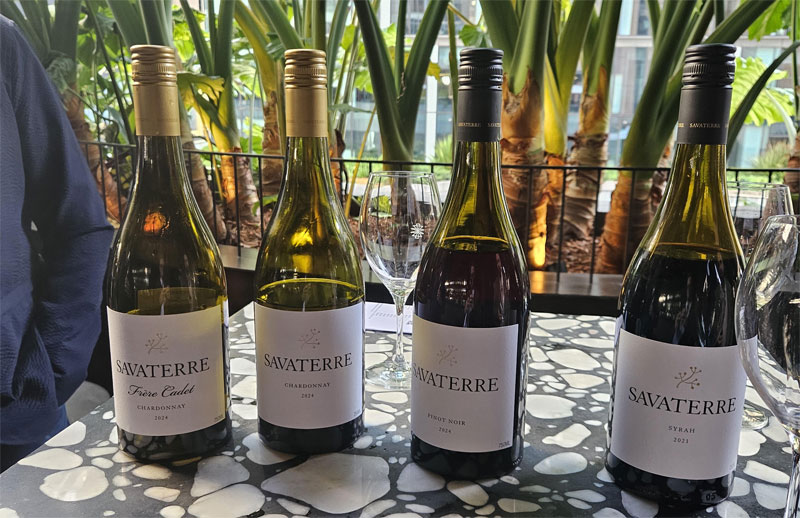
Wines are not islands unto themselves, there is always a bigger story, such as a producer, region or cultural narrative. For anyone on the production line of beauty, such as artists, novelists and filmmakers, an individual piece can only exist in a body of work, and it is this body taken as a collective from which we derive our greatest and long-lasting satisfactions.
Savaterre has been a going concern since 1996 and in the words of owner/founder/winemaker Keppell Smith “if you’re shit at what you’ve been doing for 30 years, you should probably be doing something else”.
A pioneering vigneron
Life needs a little bit of luck sometimes. Most of us know pretty quickly our shortcomings, but you can never be sure when planting a vineyard, particularly in Beechworth circa 1996. The options too are limitless, and your big investment and massive dose of stress might not pay off. Any number of things could go wrong, from varietal choice to clones and viticultural methods. There are literally infinite choices and decisions available to a pioneering vigneron, any one of which could sink the whole venture.
There will be blood and there has been blood. There will always be for just about anyone with the passion, stupidity, or gambling sense of the never never “don’t know what the fuck I’m doing but I’m going to do it anyway and send myself broke and plant a vineyard”. Happily, this is not the narrative of Savaterre.
Over the fence
To put Savaterre and Beechworth into some kind of perspective we have to peek over the fence and see what his neighbours were doing.
Giaconda started planting in 1982 not releasing their first wine until 1987. Controversially at the time, they planted their chardonnay vineyard on a cool south facing slope, the first attempt in Australia to limit a vineyard’s direct sun exposure.
Coolness and altitude were becoming a thing, but you still needed enough warmth, water and free draining soils. Beechworth it seemed, might have all three.
Castagna didn’t plant their vineyard until 1997 and were biodynamically certified from the beginning, choosing a site with very little topsoil, as Julian Castagna once told me that they wanted to be able to add organic matter and compost.
Despite Giaconda’s unparalleled meteoric rise in Australian wine, Castagna’s emphasis was entirely different stylistically, varietally and conceptionally. Shiraz became Syrah and the Italian varietals of Sangiovese and Nebbiolo took a kind of precedence. Castagna unwittingly grew to become the ‘ultimate Beechworth property’, pioneering utterly different varietals including viognier, chenin blanc, Sangiovese, Nebbiolo and classically chardonnay and Syrah, taking these further still and producing blends and variants. All wines of the most exceptional quality, stylistically very different from their neighbours; a marriage of site, culture and human reflection.
In the opposite direction, to the north of Beechworth, Sorrenberg planted their vineyard in 1985, with an emphasis on Bordeaux varietals, highlighting the region’s incredible ability to make a greater diversity of wines at the absolute pinnacle of quality. The choices, inspiration and learnings were rich indeed for Keppell Smith, but what he really wanted was Burgundy, Beechworth Burgundy and with the hefty example across the road in Giaconda, he planted pinot noir and chardonnay.
Burgundian approach
Close planting is relatively new to Australia, most vineyards being widely spaced for mechanisation and due to a scarcity of water in most wine regions. Almost all of Australia’s close planted blocks are to be found in Victoria, the earliest, Bannockburn’s Serre Vineyard planted in 1984, Lance’s Vineyard (Yarra Valley) 1989, Bass Philip in 1996 and of course Savaterre. Close planting ensured lower yields and wines of greater concentration.
Savaterre’s vineyards, whilst granitic, have deep clay subsoils, ensuring drainage and consistent water availability. Furthermore, on the southern side of the Beechworth-Wangaratta Road the soils tend to be heavier, with less topsoil and the wines, as a result, tend to present a little differently, than those grown on the northern side of the road.
Wines for everyone to enjoy
Art Deco was defined by exaggerated lines, richly coloured palates and textures, geometric and cubist forms and polished, smooth, lush surfaces. Everything about Art Deco is modern, defined, luxurious, grand and stylised ornamentation. There is also a simplicity of form, a certain obviousness that everyone who comes across it is able to understand.
Almost everyone who gazes upon a famous piece of work couldn’t care less, let alone understand it. Many fine wines, beloved by the wine industry, have almost no bearing on most wine drinkers, their secrets of greatness to be unlocked only by those of the cognoscenti. The disconnect between those in the know and everybody else is vast.
But the wines of Savaterre mirror the Art Deco paintings of Tamara de Lempicka in the obviousness of their grandeur, luxury and sheer accessibility. You don’t need to be an ‘expert’ in anything to enjoy them. Bold colour, sleek streamlined structures, a classical form draped in the brightness of modernity, the natural world clothed in culture, a sort of all consuming sensory presence and luxurious embellishments.
Tradition, with modern precision
Savaterre’s wines are pristine, pure, bright and intense. Long ageing in French oak, anything from 18 to 24 months and 30% new has its critics, but they miss the point. According to Keppell Smith, “oak’s function is to lift the wine up” and he believes his wines require this long elevage, but only because “it’s a matter of fruit power”.
The wines are never over-oaked, indeed the brightness and intensity of fruit is almost overwhelming, and the wines are certainly lifted, with intense aromatics.
The first time I tasted Savaterre Chardonnay, my immediate thought was of great Meursault – a wine that evoked the richness and generosity of a classic era. Yet the comparison only goes so far. Like Art Deco, Savaterre draws inspiration from the past without ever feeling nostalgic or imitative. It honours traditional forms while expressing them with unmistakably modern precision.
There are echoes of the great Meursaults of old in its golden hue and layered flavours of grilled nuts, buttered toast, brioche, ripe yellow fruits and a lift of fresh lime. But where some traditional Meursaults could be broad and weighty, Savaterre brings remarkable brightness, tension and luminosity. Its sculpted lines, precision and energy give the wine a contemporary edge, balancing richness with finesse in a way that is both captivating and complete.
Pinot Noir’s appeal is impossible to capture in just a few lines. Its fascination lies in the extraordinary range of qualities it can express, and it is this complexity that inspires such enduring devotion among wine lovers. At its finest, great Pinot Noir balances seemingly opposing characteristics with effortless poise: grace and power, richness and finesse, purity and wildness, vivid fruit and haunting savoury nuance, structure and delicacy, grandeur and ethereality, velvet and silk. It is in this harmony of contrasts that the world’s greatest Pinot Noirs reveal their true magic.
Keppell Smith’s Pinot Noirs are every bit as compelling as his celebrated Chardonnays, recalling an era when the finest examples were luxurious, ethereal and hauntingly elegant. Beneath their graceful, floral perfume lies a wine of remarkable depth, with impressive concentration, structure and persistence on the palate. While Savaterre Pinot Noir is undeniably pretty and nuanced, with layers of delicate red fruits and florals, it also possesses the strength and intensity that define truly great Pinot Noir.
Site takes centre stage
Savaterre’s wines are remarkable for their sense of scale and quiet luxury. They possess richness, depth and generosity, yet are delivered with such finesse that they never feel heavy or overworked. The winemaking is deliberately restrained, allowing exceptional fruit and a remarkable vineyard site to take centre stage, with carefully judged maturation in oak simply providing the time and framework for the wines to realise their full potential.
While they share the concentration and presence of Australia’s great benchmark wines, Savaterre distinguishes itself through its brightness, precision and luminosity. It occupies a captivating space between the grandeur of traditional fine wine and the purity and elegance of a more contemporary style.
Like great Art Deco design, Savaterre has an enduring appeal because its beauty is both immediate and timeless. There is nothing contrived or inaccessible about these wines. They speak with clarity and confidence, rewarding both the seasoned collector and the curious newcomer alike. You don’t need to be a wine expert to appreciate their charm – only a glass in hand. The finest wines have a way of making their greatness feel completely natural, and that’s what makes Savaterre so compelling.
From one of Australia’s earliest close-planted vineyards, established on granite and clay soils, this is a Pinot Noir of remarkable presence and refinement. The aromatics are expansive and deeply expressive, revealing an intensely floral bouquet layered with English summer berries, blackberry, mulberry, tar, exotic Lebanese spices, a wisp of smoke and the first savoury hints of cured Serrano ham.
The palate is powerful yet exquisitely composed, with concentrated fruit delivered in finely etched detail. Every element is sculpted and focused, supported by beautifully integrated, velvety tannins and a vibrant line of acidity that carries the wine effortlessly across the palate. There is an unmistakable sense of scale and gravitas, yet the wine never loses its poise or energy. It combines power with elegance, richness with precision, creating a Pinot Noir of extraordinary tension, persistence and finesse. A truly grand expression of Savaterre, where intensity and grace exist in perfect harmony.
Like all of Savaterre’s wines, there is an immediacy from the very first sip- an arresting intensity that leaves no doubt you are tasting something special. It is a wine of remarkable generosity and presence, delivering a sense of luxury that far exceeds its price. Brilliantly aromatic, it opens with vibrant lime and grapefruit, layered with smoke, toasted spices, grilled nuts, yellow peach and a hint of browned butter. The palate is expansive and powerful, yet never heavy, lifted instead by a vibrant thread of tangy acidity that gives the wine energy and drive. Despite its richness, every line is beautifully defined, with striking clarity and purity.
Complex and captivating, citrus and orchard fruits intertwine with notes of buttermilk, cashew and subtle oak spice, creating a wine of remarkable depth and precision. It possesses the grip and persistence that mark truly great Chardonnay, with flavours that linger long after the final sip. Built to reward patience, this is a wine with decades of evolution ahead.
Savaterre Frere Cadet Chardonnay 2024
According to Keppell Smith, this chardonnay is from a neighbour’s vineyard, and if I had to guess, I would think it’s the wonderful Indigo vineyard. It’s even more dialed up than the estate in terms of lifted aromatics and luminosity. Orchard fruit, lime, grapefruit, wood spice, cashew and buttered toast combine on a bright, slick and streamlined palate. Terrific energy and tightly wound, a surging drive of acidity that’s beautifully cut and penetrating.