



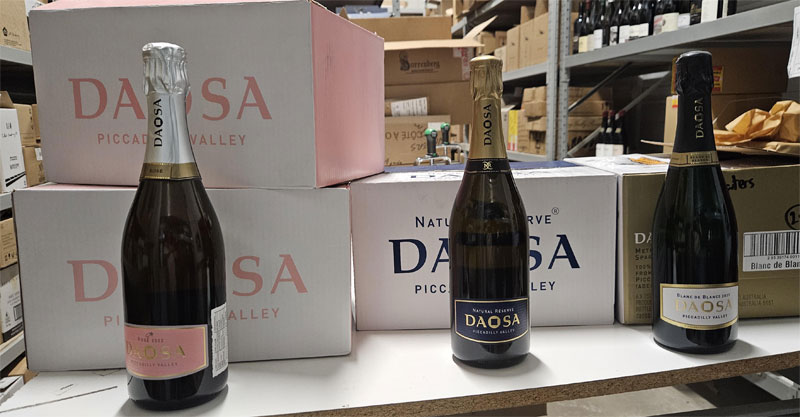
Most Australian sparkling is a blend of vineyards, many of which share no relation except to say that they are blended to create a wine.
Even in Tasmania, home to many of the nation’s finest, almost all noteworthy sparkling wines are made from purchased grapes, often from across the entire state. I don’t have a problem with this, being a fan of blending, whether it be varietals or sites, but it also highlights the fact that there are very few complete vineyards for sparkling anywhere.
Champagne as we know is usually a blend, including some of the finest vintage wines, and even single site or village wines from some of the most iconic growers and esteemed vineyards are producing Champagnes of great singularity. But are they complete wines? They may be a terrific expression of terrior, but that doesn’t necessarily make for great drinking.
No. There are very few sites that are capable of making ‘complete’ wines, of any description. They are rare by their very definition and so coveted that in Europe at least, there is swathes of legislation denoting and protecting the efficacy of these great sites.
But Champagne is different. The greatest wines are blends. Period. Similarly Bordeaux. From the perspective of vineyards, the greatest estates of the 1855 classification are entirely different now compared to 1855. Through the years they have been added to enormously, and whilst their wines are from estate holdings, they are in essence blends, not only of varietals, but of sites too. In blending they find the infinite possibilities that only a mosaic of sites can deliver. For the moment, Australia has only one producer who farms a tapestry of vineyards capable of not only making sparkling’s of such thorough completeness, not to mention variety, but wines that are of their place – Daosa.
A champagne pedigree
Champagne has to be the benchmark. It’s worth noting that the Daosa vineyard has Bollinger pedigree, having been planted in 1995 by Christian Bizot, the chairman of Champagne Bollinger.
The Piccadilly Valley has similarities with Champagne, benefitting from long growing seasons and abundant water, but its differences are pronounced.
The site and surrounds
Firstly, the Piccadilly Valley is at altitude. The winters are cold, the summers scorching hot, but the nights are cold, and it’s this diurnal difference that prolongs the growing season and ensures the grapes have very high natural acidity.
Malic acid is also exceptionally high. Many producers of Champagne are opting to block malolactic fermentation due to the low acid levels of hot, early vintages; to maintain ‘freshness’ and this has altered the profile of many Champagnes. Malic acid presents a different fruit profile of green apple, unripe lemon and unripe stone fruits creating a sour presence that tires the palate. Daosa’s sparklings all undergo malolactic conversion, the fruit being ripe, but perfectly balanced through high natural acid levels.
The Piccadilly Valley receives double the rainfall of Champagne, much of it in winter. The soils are free draining, with rock fragments of shale sandstone and schist, and range from clay loams to heavier clay dominant soils. Vines are close planted, 1.5m by 1.5m and worked by hand. Yields are draconian at 6 tonnes per hectare, or 1.5 tonnes to the acre, a far cry from Champagne where permitted yields can top out at just over 6 tonnes, but have been as high as nine in 2004. Daosa’s sparklings are consequentially concentrated, complex and intense and coupled with the Piccadilly Valley’s growing conditions, display abundant freshness and powerful structures.
Bizot vineyard
Daosa manages and owns 35 blocks across the valley, but the heart of the matter and the estate’s signature sparklings come off their own Bizot Vineyard. Custodians Xavier Bizot and Lucy Croser’s mission is to create Piccadilly sparkling, not Champagne. The Daosa Blanc de Blancs is 100% Bizot Vineyard and 100% chardonnay. Whole bunch pressed, with both primary and malolactic fermentations and ageing in old French oak barrels on lees for 6 months, before transferring to bottle for at least three and a half years on lees. They are some of Australia’s finest and I believe long lived single vineyard Blanc de Blanc sparklings.
Very few vineyards, anywhere in the world are good enough to produce single vineyard wines. Almost all wines benefit from being a part of a blend, and only the very best sites accomplish a complete wine from a single varietal. Ironically, these are the easiest wines to make, with processes of viticulture and winemaking enabling clear thinking and streamlined decision making.
Blended brilliance
But it’s the Daosa Natural Reserve where the skill of the producer is most evident. Three varietals, not one, that all have to be farmed and vinified differently, not to mention that fruit is drawn from 35 sites all over the Piccadilly Valley and as the estate matures, the greater use of reserve wines. Whole bunch pressed, both fermentations occur naturally in stainless steel tanks, before ageing in old French foudres for at least 19 months, although this varies year to year according to the vintage. Wow fizz. Wow. That was my note upon tasting the Natural Reserve 8th Release, absolutely the best sparkling in Australia at this level and the best value. I simply couldn’t believe how much my expectations were blown out of the water.
Meunier magic
Pinot Meunier anyone? Only three out of the 35 blocks are of Pinot Meunier, the rest, 16 each of chardonnay and pinot noir. Pinot Meunier loves sunshine and the wines tend to be richer, broader, softer and more open than pinot noir. It is, however, to be taken just as seriously and if you are lucky enough to have tasted from producers like Eminence of Whitlands in Victoria’s Alpine Valleys and of course Daosa, you would know what I’m talking about. Pinot Meunier makes two thirds of the Daosa’s Vintage Rose, alongside pinot noir (30%) and chardonnay (4%). Whole bunch pressed to tank for both fermentations and ageing, before spending 22 months in bottle on lees. The results are gorgeous. Seriously gorgeous.
A tip from a master
Brian Croser, whose daughter Lucy is one half of Daosa, has outlined a criterion of nine when judging the quality of a wine.
1 – Freshness
2 – Intensity
3 – Complexity
4 – Palate. Tastes as it smells.
5 – Fruit sweetness.
6 – Texture
7 – Balance
8 – Length
9 – Longevity
If I’m to use these nine, and why not, Daosa is Australia’s most exciting sparkling wine prospect.
Daosa Natural Reserve 8th Release
75% 2023 vintage, 25% reserve wine from 2022 and 2021. Pinot Noir (62%), Chardonnay (29%) and Pinot Meunier (9%). The Piccadilly Valley’s answer to Brut Champagne, spending 20 months on lees. Terrific aromatics and complex to boot. Grapefruit, pithy citrus, ginger, honeysuckle, nougart, lime, green peppercorns, strawberry, and red apple. Intense, balanced and mellowed and so easy to drink. Concrentrared, with extract and texture, a fine bead and a powerful, silky palate. Stunning sparkling, very long indeed, with quite a few years of pleasure ahead.
Pinot Meunier (66%), Pinot Noir (30%) and Chardonnay (4%). The Pinot meunier really shines, with very open aromatics of strawberry, cinammon, raspberry, sandlewood and Scotch Finger biscuit. Rich, full bodied, soft, open and creamy. As with all Daosa sparklings, some extract and texture to fill and grip the palate, which is very long, flecked with pink peppercorns. Fabulous, gorgeous, plush exuberance.
100% Chardonnay, 100% Bizot Vineyard in the Piccadilly Valley. Subtle aromatics of oak spice, white flowers, madarin blossom, white peach and roasted walnut. Velvet, almost silky, focused, concentrated and utterly fine. White and yellow peach, grapefuit, white cherry, pink lady apple and savoury spice. Seamless and effortless, one of the finest Blanc de Blancs in Australia.
Daosa Late Disgorged Blanc de Blancs 2017
I don’t usually love sparkling or Champagne that spends this amount of time on lees, 90 months in this case. There can be too much savouriness and leesy-ness, without enough freshness or fruit. However, the Daosa Blanc de Blancs is gorgeous, mineral, generous and intense, without any loss of freshness or fruit profile. It’s a remarkable feat in sparkling winemaking and a testament to the quality of the fruit coming off the Bizot site. Honeycomb, spring jasmine, ginger biscuit, white and yellow peach, toasted almonds, cooking spices and apricot marmalade. Silky, fine and long, perfectly balanced and with a sense of effortlessness, with nothing forced. Unlike so much Grower Champagne, it doesn’t try too hard. If it’s a statement of sorts, it’s pure, drinking pleasure.