
Ageing wine has got to be the most boring and tedious aspect to winemaking. You feel as if you should be doing something, anything to soak up time or a task that will wave an imaginary wand and improve the wine beyond all hopes.
But that’s not how it works. Time and a little bit of air is your friend.
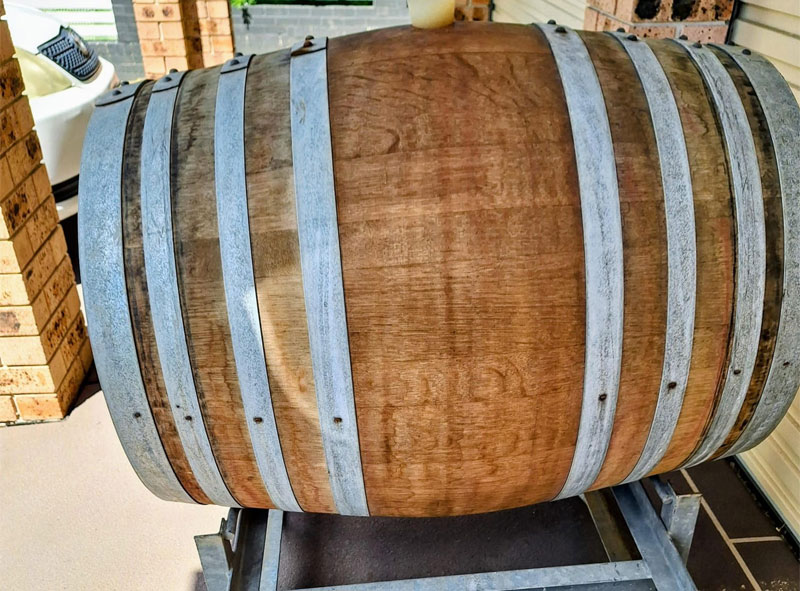
If the wine is being aged in a porous vessel, an oak barrel for instance, evaporation will naturally occur and the vessel will have to be ‘topped up’ every couple of weeks. From time to time, the wine will need ‘racking’, the process of taking the wine off its sediment, and the vessel cleaned and the wine put back in. You might have noticed that oxygen plays a key role and as breathing could be misconstrued as boring, so it is with waiting for wine to be ready. Ready to be bottled that is.
My wife and I took the kids to Vivid with another family, and as any intrepid Sydneysider knows, if you can bring your own bottle, you really should. You know that whatever’s going to be on offer will be something verging on Dante’s inferno, and you’ll be paying through the nose only to have your nostrils assaulted. So I brought along a reputable bottle of 2021 Grenache from WA.
It was a disappointment. In the dim evening light, one of us wasn’t even sure of the colour, and it just didn’t taste of much. I describe these wines as dry reds, neither here nor there and although there is nothing wrong with them, the dullness makes me crave a Peroni.
In the interests of frankness here is my tasting note from 2022:
A higher level of refinement has crept into the 2021’s, compared to the sleek, puckering wines of 2020. Pretty aromatics of jubey red fruits, tangy hedge fruits and brooding black fruits. Pure, flecked with flowers, ironstone and spice. The fruits are very complex, light and dark, sweet and tangy. The shape and mouthfeel are gentler, more supple and slightly rounder, the tannins of very fine lace. Beautiful wine
Why is the wine so totally different now, in a dry-reddie kind of way?
Elevage is the period of time after fermentation that the wine will spend ageing, prior to bottling. Having similar experiences with many a ‘good’ bottle recently, I noticed that in almost all cases, the elevage was around 10 months. And herein lies the problem.
Ageing timeframes have come back in recent years, indeed a full two years (or two winters) was pretty standard with Burgundy of any colour, and this in Burgundy pieces of 228 litres. These days, many producers have moved to larger formats for much shorter periods, often less than a year.
Another common trend in Burgundy is to move the wine into cement or steel for further aging to freshen and pull the wine together. The results are obvious. Gone are the monoliths, with their strong frames, full bodies, deep colour and unctuous extract.
The Burgundies of the 2020’s are pert, sleek, high toned, bright and tightly wound, their acidity more prominent as if to make a virtue of it. There is an immediacy to these wines, the form finely cut, and a structure of linear precision. So what’s the problem?
Firstly, we should look at why pretty much all wine we drink goes through some form of ageing prior to bottling. It’s worthy of a book, but I’ll keep it short.
After a wine has finished fermentation (including malolactic for reds and some whites) it tastes and feels pretty edgy and not particularly pleasant. Elevage softens and integrates the components and through micro-oxygenation with porous vessels, wine puts on weight, flesh and, despite the tannins becoming more prominent, elevage tends to soften their impact.
There are limitless variables and options available to the winemaker, such as what kind of vessel, it’s size, age and composition. But time, that creeping thief, how much time?
Shorter elevages will certainly craft a ‘brighter’ wine. My contention is that ageing wine for a shorter period produces a wine that is ultimately less complex and, in the fullness of time, less interesting. Wines made in this fashion will taste delicious for up to three years from bottling and then, henceforth, a graceless decline.
Once again, the wine isn’t bad, and despite its obvious structure and fruit intensity, it’s only natural to assume a long life and aggregated pleasure in future years, but you would be wrong. It is also my contention that this process leads to greater homoginisation, less site expression and down the vista of years, loss of varietal typicity.
In Australia, it is certainly the fashion to give reds and wooded whites about 10 months before bottling.
Fitting neatly into the rhythms of a vigneron, bottling can take place before the new vintage, vessels and equipment cleaned and the cellar ready for the new harvest. So it is a logistical decision as much as anything else, but if you have the space and financial capacity, would better wines be made if left longer? I believe they would.
When I first encountered Burgundy in the UK 25 years ago, the differences between villages and sites were far more obvious than they are now. Meursaults huge, full of dry extract and dripping with buttered honey, toast, yellow flowers, daker stone fruits and unctuous lime.
Times have changed to such a degree, that I find it almost impossible to tell a Chassagne from a Puligny, or a Chambolle from a Vosne. Pommard used to be rugged and structured, and now…..
If you don’t believe me, open a bottle of chardonnay from a renowned, ‘modern’ Yarra Valley producer, with plenty of bottle age and you will taste what I mean. They will remind you of a fuller bodied Hunter Valley semilion. Nice enough, and yes, fresh and pristine, but so simple and so bloody boring.
These wines do age, many of them for a very long time, but just not very well. Wine journalists love these wines, routinely awarding high praise in the form of large points, but drink them within a couple of years.
If you want beautiful complex wines to grace your cellar, with many years of pleasure, purchase those that have undergone extended elevage, at least 12 months and preferably more. Trust me.