
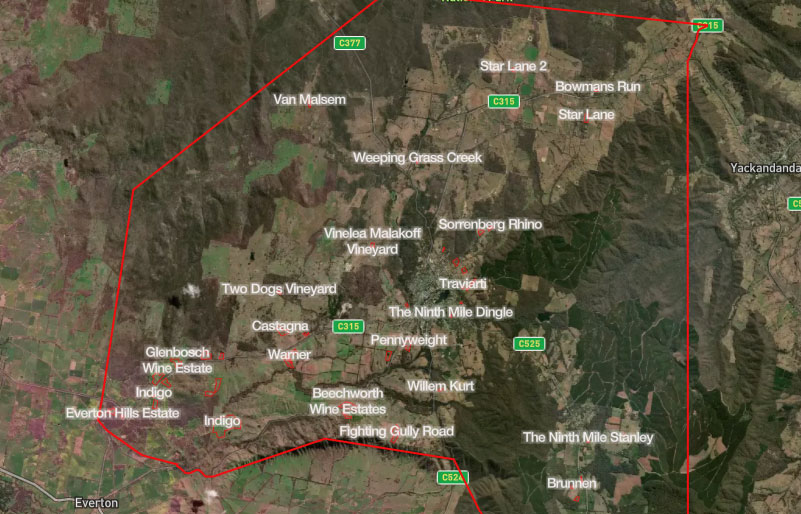
If you were to stand in the middle of town clutching a Beechworth winery map, facing north, holding a compass and a topographical map of the region, you will notice that the region’s elevation is relatively uneven, patchworked and hilly to the eye, but that in general terms the higher elevations range from 40 degrees, through to 170 degrees, to the east of the township.
Vineyard elevations range from anywhere between 400m and 800m, however, most vineyards are below 600 metres, suggesting that this is the upper limit for the successful ripening of grapes. To complicate matters, the region has a variety of soils, with mudstone, granites, clay and shales, to be found at varying depths. Top soils too play their role and due to the areas complex topography, you can stand in a vineyard with abundant top soils, whilst the neighbour across the road has very little.
For wine lovers obsessed with detail, Beechworth will turn your hair grey. For one thing, it’s as if the vineyards randomly fan out from the town in all directions. This isn’t Burgundy, with its neat maps, one road north to south and clear soil and topographical delineations.
Not to mention Burgundy’s strictly limited permissible varietals, defining wine styles, centuries of accumulated knowledge and seemingly logical reasons as to what makes one vineyard better (or different) from another.
As you look to find patterns in Beechworth of why the best vineyards and producers are where they are, what their commonalities might be and what the regions defining characteristics, varietals and wine styles are, you will have to acknowledge to yourself, that Beechworth will not be able to answer any of these questions for you. It is very much a kind of vinous anarchy.
Amongst the locals I’ve heard the phrase “golden mile”, or in Julian Castagna’s words “if this was Burgundy it would be Grand Cru” a number of times. And why not. On the Beechworth-Wangaratta Road to the south-west of Beechworth is Giaconda, Castagna, Savaterre, Warner vineyard, the Indigo vineyard (the region’s largest with 50 hectares), Domenica, Piano Piano and Weathercraft, not to mention others that I am not familiar with.
The first three names are just about three of the most famous names in Beechworth, not to mention in Australian wine, but for me they are living proof of the region’s punishing ability to obfuscate anyone trying to make sense of it all.
And this is no contradiction in terms, as they all make world class wines, but it has to be said utterly differently. If this was anywhere else in the world, there would be far more commonalities than differences, however, Beechworth’s logic is a kind of glorious chaos. Giaconda, Castagna and Savaterre have totally different approaches, viticulturally and oenologically, and for the wine lover, the diversity and choice is salivating.
More confusing still, is the contradiction that if this indeed is the “Grand Cru” of Beechworth, where would you place Traviarti and Sorrenberg, situated in the opposite direction to the north-east and east of the town, with their totally different varietal makeup? And what about Fighting Gully Road on the southern extreme boundary of the region with varietals as different as verdicchio and grenache?
Traviarti under Simon Grant (his last vintage was the 2024, alas) was the first producer who allowed us to glimpse a future that was nebbiolo (and a chardonnay that was the envy of all of Beechworth’s vignerons) whilst Sorrenberg’s three hectare vineyard is home to one of Australia’s finest Bordeaux iterations, red and white and a gamay that sits equally alongside the By Farr and Reed Wines examples as the continent’s finest.
Twisting your vinous comprehension to the Rhone, Sorrenberg have planted the Rhone varietals Grenache, Mourvedre, Shiraz, Carignan and Cinsault, releasing wines under the Juliard label, that are mind bendingly different from the elegance and cool grace of their Bordeaux styles.
Blessedly, as far as I’ve tasted, there are no orange wines or ridiculous ‘natural’ wine abominations to sully the region’s reputation and considering what’s on offer there needn’t be. Such wines are almost always the products of bad or average vineyards and there aren’t too many of those in Beechworth.
I just hope the region continues to explore the diversity of options that have helped carve its reputation and not fall into the trap of a sort of hyper focus on trendy varietals such as nebbiolo, chardonnay and pinot noir.
Fighting Gully Road has just released a Petite Arvine, a Swiss varietal that I’d never heard of. Beechworth’s the gift that keeps on giving. And I like the fact too that Castanga’s chardonnay is a world away from Savaterre’s, despite being neighbours, on opposite sides of the road.
If there is one established wine style that I’d like to see more of, it’s Bordeaux styles. Adrian Rodda has two, his more expensive Tete de Cuvee is gorgeous for its luxury and pinpoint balance, but best of all, Sorrenberg’s exquisitely grand Cabernet Sauvignon / Cabernet Franc / Merlot is too beautiful for a copy not to be attempted.
If there is any logic to Beechworth, in no particular order, it’s these three attributes; quality, value and diversity. Fashion is the greatest threat, and farmers need to be sure not only of the quality of their product, but also the commercial viability of the wines they happen to produce. So, in Beechworth, take a look around, embrace the anarchy and drink the total opposite to your first choice.