
If you are to look at a map of Tasmania and superimpose its wineries, you might be struck by the diversity of locations, locations that are essentially coastal, or near enough to it, or some other body of water, like a river, dam or estuary. Cool environs, and soils that are usually fertile enough to ripen grapes, but not too much, and fingers crossed, a supply of rainfall that ensures vineyards can be dry grown.
Tasmania is not a coastal climate, but rather an island climate, resulting in capricious weather gods and variable vintage conditions. However, the greatest variable of all are the producer’s themselves. it is still too early to make pronouncements that one region or another produces wines of a particular style, or stylistic footprint, but if I had to narrow the field, my favourite producers tend to be from the Huon Valley, and the two finest are unquestionably Home Hill and Sailor Seeks Horse.
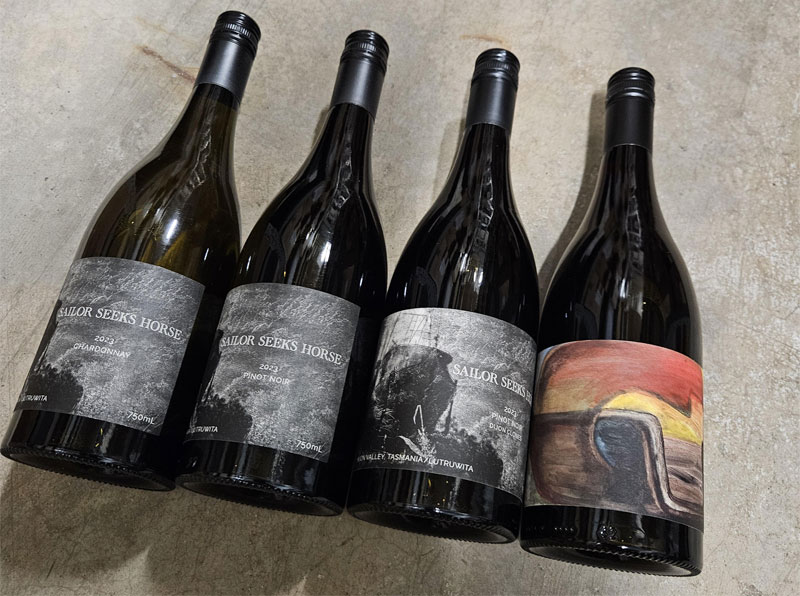
It is a coincidence that Paul and Gilli Lipscombe worked for Home Hill, and that their first wines were made in the Home Hill cellar. The two wine styles are utterly different however, a reflection of site and style preferences. I was lucky enough to recently taste twenty-seven Sailor Seeks Horse wines, including all vintages of chardonnay and all, except the very first of pinot noir. All wines showed beautifully, the differences mostly pertaining to vintage variation and the subtle tweaks of winemaking.
Great sites and great producers are consistent if nothing else and curiously, from the very first vintage, the style of Sailor Seeks Horse was anchored. The site is sloped and warm, and it needs to be in the context of the Huon Valley, if you have any chance of ripening. Quartz soils with mudstone over clay, the vineyard is dry grown, and worked organically. A wide variety of clones have been planted, and although the Lipscombe’s have identified what they believe to be the best clones, and the best parts of the vineyard, I get the impression that nothing is taken for granted and that there are no givens. Every day and every vintage is a time for refection and observation.
Paul and Gilli Lipscombe on the 2024 vintage:
This meticulous fruit selection enabled us to produce wines of a purity and intensity that has delighted us in a year where we felt challenged by the conditions. We were unsure how many individual wines we would be able to make but as elevage continued there became a distinct difference between the parcels, worthy of separation. It’s always a pleasure to create wines we are proud of in these years. Perhaps it’s a testament to the vineyard itself but we suspect there’s an element of making sacrifices and not taking the short cuts too. There is also that time for reflection on what we do and how we do it, always attempting to improve and not being tethered to dogma. Maybe sometimes it’s ok to let go of a philosophy such as dry farming in a year like 2024 and in a future that looks uncertain we have to be open to new ideas. After all, as the economist John Maynard Keynes probably didn’t say, “When the facts change, I change my mind. What do you do sir?”